
Quick answer
For a first trip to mainland China, prepare one map with usable local routes and a separate Chinese address card. AMap Global is a practical starting point to check, because its publisher lists English. Test it with your actual hotel and arrival station; do not choose solely from an old “best app” list.
Hong Kong coverage and mainland coverage are different questions. An app working in Hong Kong does not establish that it can plan a journey in Shanghai or Beijing.
Compare by the job you need to do
| Option | When to check it | Before relying on it |
|---|---|---|
| AMap / Gaode | Local place search and walking or transit directions | Confirm the English option, Chinese branch name and final entrance. Start with the AMap guide. |
| Apple Maps | You already use an iPhone and want a familiar interface | Search the exact trip and check the feature availability list. Features vary by place. |
| Baidu Maps | Staff or your accommodation sends you a Baidu location | Keep the Chinese name; check that you can understand the route before leaving. Do not assume every menu is English. |
| Citymapper | A city you need is explicitly covered | Check the selected city and an actual route. Hong Kong support should not be extrapolated to mainland cities. |
| Google Maps or another familiar service | Cross-checking information before travel | Test access and the specific route separately. A page loading is not proof that its local listings or transit data are current. |
| Saved address card | Data, login or navigation fails | Save it on your phone before leaving; include the property name, address, entrance and telephone number. |
This table is a task-based selection guide, not a comparative field-test score. We have not tested every app on every phone or in every city.
Does Citymapper work in China?
Citymapper's official data-source directory explicitly lists Hong Kong transport providers. It does not list Beijing or Shanghai in that directory as checked on September 11, 2026. This is a reason to verify your mainland destination rather than assuming coverage, not a claim that every future version will have the same service area. Citymapper data sources.
Before travelling, select your destination city in Citymapper and try the exact station-to-hotel journey. If the city or usable route is unavailable, prepare AMap or another verified local option. For a trip that includes Hong Kong and mainland China, make this check for each city separately.
What to check in AMap's English mode
The AMap Global publisher listing includes English. That helps with the interface, but you should still verify the city, hotel branch, transit direction and entrance. Keep Chinese names unchanged when copying them between a booking, a map and a taxi order.
An English map interface also does not establish that a ride-booking partner accepts your phone number or payment method. Complete that check in the actual booking flow before depending on it for an airport transfer.
A five-minute test before your trip
- Ask your accommodation for its complete Chinese address and a recognisable entrance.
- Search that address in your chosen map. Match the city and district.
- Plan a route from the correct airport terminal or railway station to that property.
- Read the walking legs and transfer instructions. If you cannot interpret them at home, prepare translation or another route now.
- Save the address and useful screenshots outside the map app. Check that you can open those files without mobile data.
If two apps disagree, check the most important detail first: the destination. A slightly different travel time is less urgent than being directed to another hotel branch.
Try your exact destination in each app and compare the complete route, including the final walk.
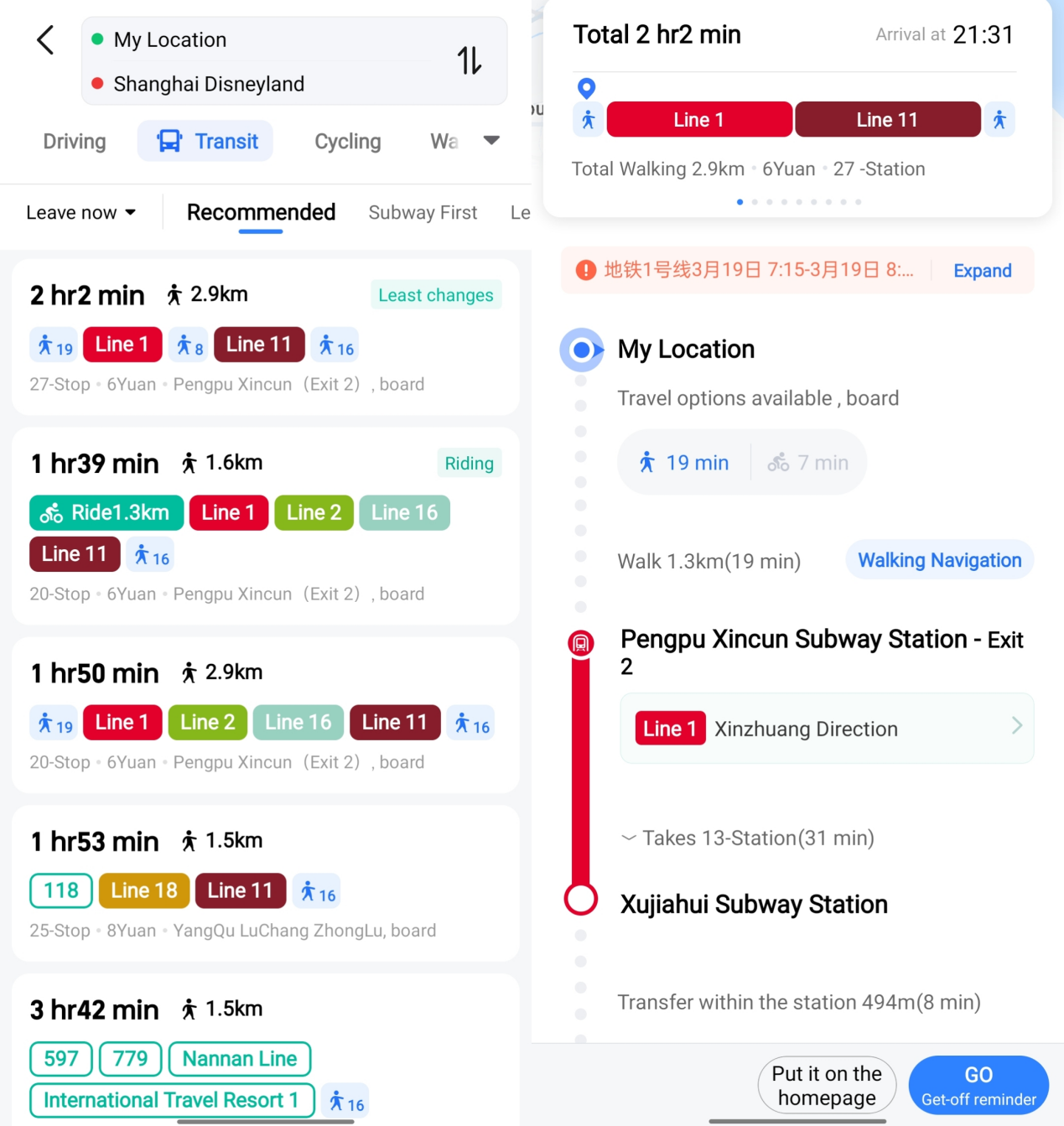
AMap route example. Check the Chinese place name, route mode and final destination.
Image source: Shanghai International Services. Screenshot rights remain with the publisher. Reference example; screens can vary by device, account and app version. Dates and prices shown are not live.
Read the final part of the route
The last few hundred metres can require an underpass, a particular station exit or a different side of a building. Zoom in before walking. If you have large luggage or need step-free access, ask the station or property about the usable entrance rather than assuming the shortest route is suitable.
Transit directions, opening hours and service interruptions can change. Check current signs and staff guidance when the app conflicts with conditions around you.
Keep a fallback you can show someone
Use the address card tool to prepare the hotel name, Chinese address and phone number. The offline travel kit explains what else to save. A screenshot is a useful reference; it will not update when a route closes or a train time changes.
FAQ
Which map should I install first?
Try AMap Global for your actual China destinations, then keep a familiar alternative if it successfully handles the same routes on your device. The useful choice is the one you can read and verify.
Does an English interface translate everything?
No. Treat English menus, local business names, alerts and partner-service screens as separate checks.
Is a Hong Kong route enough to test a mainland trip?
No. Verify each destination city and connection separately, including the mainland station or airport you will use.
Sources and review
Sources checked September 11, 2026. Selection checks and fallback steps are editorial guidance, not a comparative field test.